

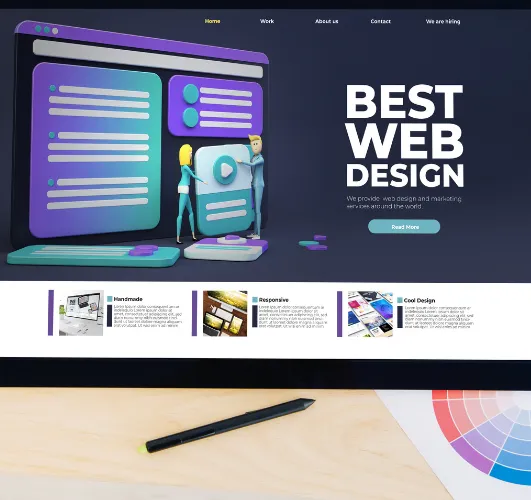
Yes, your business needs a website, even if you already have an active Facebook page and a Google Business Profile. Social profiles and directory listings are rented space with someone else's rules. A website is the one place you own, where you can explain every service, answer the questions people ask before they call and capture leads you can follow up on. This guide covers what a website does that a Facebook page can't, how it works with your Google Business Profile, what a minimum useful small business site includes and what it costs in the Statesville, Lake Norman and Charlotte area.
Rented space vs. a site you own
A Facebook page, an Instagram account, a Yelp listing and a Google Business Profile are all useful. But you don't own any of them. The platform decides how your page looks, what information fits, who sees your posts and what's allowed. It can change those rules at any time, and you have no say.
Accounts also get locked or hacked. If your whole online presence is one social page, a locked account means customers can't find you.
A website on your own domain works differently. You control the content, the layout and the contact options. Your domain stays with you if you switch designers or platforms. And it gives every other profile something solid to point to. Think of social media and directories as the signs on the road, and your website as the building they point to.
- You own the domain and the content, so it moves with you
- No one else decides who sees it or what it can say
- Your email address can use your own domain instead of a free account
- It's still there if a social account is locked or a platform loses popularity
Where your Google Business Profile fits
For most local businesses, the Google Business Profile is where people first see you. It shows up in Maps and the local results with your hours, reviews, photos and a website button. Google says local results are based on relevance, distance and prominence, and that prominence includes reviews and links (Google Business Profile help).
The profile only holds so much. When someone taps the website button, they want more: what exactly you do, where you work, what it costs and how to book. If that button leads to a Facebook page with a few recent posts, or nowhere at all, you've lost the chance to answer them.
A website also gives Google more to work with. The profile and the site work together. Neither one replaces the other.
Service pages are how you show up for what you actually do
Whitespark's 2026 Local Search Ranking Factors survey found that dedicated service pages are the top factor for local organic results, and that the primary Google Business Profile category is the top factor for the local pack (Whitespark). That's a survey of experts, not a guarantee.
A Facebook page can't do this. It has one About section and a feed of posts that scroll away. A website can have a separate page for each service, each with its own description, photos, pricing guidance and questions answered.
Say you run a small roofing company in Mooresville. People search for "roof repair," "roof replacement," "storm damage roof inspection" and "gutter installation." One page that lists all four as bullet points tells them very little. Four pages, each explaining the work, the process and what to expect, give each search a real match. More on this for contractors and in our guide to local SEO.
One caution. Don't build dozens of near-identical pages for every town name with the city swapped out. Google treats pages built to target cities that all funnel to one place as doorway pages, which is against its spam policies. Write location pages only when you have something real to say about working there.
Answer the questions people ask before they call
Most customers do some homework before they pick up the phone. They want to know if you handle their problem, if you work in their area, roughly what it costs and whether you're trustworthy. If your site answers those questions, the calls you get are better. If it doesn't, people move on to a competitor whose site does.
Write down the questions your team hears every week. Those are your website content. A few common ones:
- Do you serve my town, and how far do you travel?
- What does this usually cost, or what affects the price?
- How long does it take, and how soon can you start?
- Do you take my insurance, or do you work with insurance claims?
- What happens at the first visit or appointment?
- Are you licensed and insured, and what warranty do you offer?
Credibility: the site is your storefront
People size up a business fast. A clear, current website with real photos of your work, your team and your location signals that you're established and paying attention. A missing website, or one that hasn't changed in years, raises questions you don't want customers asking.
This matters most for high-trust decisions, like choosing a vet, a builder or a consultant.
Things that build trust on a website:
- Real photos of your work, team and location instead of only stock images
- Your phone number, address or service area and hours, consistent everywhere
- Licenses, certifications and memberships you actually hold
- Genuine reviews and testimonials, quoted accurately with permission
- An About page that says who runs the business and how long you've done it
Lead capture and follow-up
A website can do more than display information. It can collect leads and start the follow-up for you. A form or booking tool can collect the details you need, confirm the request and notify you right away.
Say you run a veterinary practice in Statesville. A new client lands on your site at 9 p.m. They can see your services, read what a first visit involves and request an appointment. The request reaches your team in the morning with the pet's name and reason for the visit, instead of a vague voicemail.
Useful lead capture features for a small business site:
- A tap-to-call phone number on every page, especially on phones
- A short contact form that asks only for what you need to respond
- Online booking or appointment requests where it fits the business
- Automatic confirmation emails or texts so people know you received the request
- Notifications to the right person on your team
Your marketing hub
Every other kind of marketing works better when it has a place to send people. Social posts, Google Business Profile updates, email newsletters, yard signs, truck wraps, QR codes and printed flyers all need a destination. A website gives each one a page that explains the offer and gives a clear next step.
It also shows you what's working. Analytics and Google Search Console show which pages people visit, which searches bring them in and which pages lead to calls.
If you sell products, the site can do even more. An online store takes orders around the clock, handles payments and gives customers a way to buy without calling.
What a minimum useful small business website includes
You don't need a huge site to start. You need a site that answers the basics clearly and makes it easy to contact you. For most local service businesses, five well-written pages is a solid starting point.
- Home page: who you are, what you do, where you work and a clear call to action
- Service pages: one per main service, with the questions customers actually ask
- About page: the people behind the business and why someone should trust you
- Service area or location information that matches your Google Business Profile
- Contact page: phone, form, hours and booking if you offer it
- Real photos, reviews and examples of your work
- Mobile-friendly design, since many local searches happen on phones
- Fast loading, secure connection (https) and basic accessibility
- Analytics and Google Search Console set up from day one
What a business website costs in this area
Our published prices include five pages. A drag-and-drop site starts at $1,500, plus $150 per extra page. A custom AI-built site starts at $2,500, plus $200 per extra page. Both of these are hosted inside the Savvy Sales System plan. A WordPress site starts at $2,800, plus $250 per extra page, with $75 a month for managed hosting, updates and backups. An online store starts at $4,500, plus $250 per extra page, with $150 a month for store care, and platform fees are separate.
Typical timelines for five pages, once we have your content and logins, are 3 to 4 weeks for drag-and-drop or custom AI-built sites, 4 to 5 weeks for WordPress and 5 to 7 weeks for an online store.
For comparison, our October 2026 review of published prices from studios around Statesville, Lake Norman, Hickory and Charlotte found template sites starting under $1,000, typical small business builds at $2,500 to $4,500 and large custom builds at $8,000 to $15,000 or more. Most local studios don't publish prices at all. The full breakdown is in our guide to website costs in North Carolina, and our instant estimate gives you a range, monthly cost and timeline in about two minutes.
Pairing the site with follow-up tools
Some businesses want the website to do more than collect a form. The Savvy Sales System, which we run with Jen Schneider's Savvy Sales Strategist, is an all-in-one platform of this kind. It includes a CRM, two-way texting, email, online booking and reminders, missed-call text-back, pipelines, review requests to every customer and a unified inbox. Plans start at $297 a month, and the Growth System includes a fully built website or funnel and automated follow-up. There's a 14-day trial. You don't need any of this to have a good website, but if leads slip through the cracks today, it's worth a look. See our automation services for details.
Next steps
If you don't have a website yet, start by listing your main services, your service area and the ten questions customers ask most. That list is the outline of your site. If you already have one, check it against the minimum list above and fix the gaps first.
SS Design Media is a founder-led web design and local SEO studio in Statesville, founded in 2013 by Steven Schneider, who has designed websites for more than 15 years. You can see published projects such as Brawley Animal Hospital in our work, learn more about our web design services or contact us. We reply within one business day.
Common questions
Do I need a website if I have a Facebook page?
Yes, for most businesses. A Facebook page is useful for updates and conversation, but you don't control its rules, layout or reach. A website gives you a place you own to explain each service, answer common questions and capture leads.
Is a Google Business Profile enough without a website?
It's a strong start, but it holds limited information. People who tap the website button want details on services, pricing, service areas and booking. A website gives them those answers and gives Google more information about what you do.
How many pages does a small business website need?
Five pages is a good starting point for most local service businesses: home, a few service pages, about and contact. Add a separate page for each main service as you grow, since each one gives customers and search engines a clear answer about that service.
How much does a small business website cost?
At SS Design Media, five-page sites start at $1,500 for drag-and-drop, $2,500 for custom AI-built, $2,800 for WordPress and $4,500 for an online store. WordPress and online stores also have monthly care plans. Our instant estimate at /estimate gives a range, monthly cost and timeline in about two minutes.
How long does it take to build a business website?
For a five-page site, once content and logins are in hand, drag-and-drop and custom AI-built sites typically take 3 to 4 weeks. WordPress sites take 4 to 5 weeks and online stores 5 to 7 weeks. Gathering content is often the step that takes longest, so start on it early.
Will a website get my business to the top of Google?
No one can guarantee a top ranking, and Google states this directly. A clear site with dedicated service pages, accurate business information and a well-managed Google Business Profile gives you a fair chance to show up for the services you offer.
The takeaway
Keep your Facebook page and your Google Business Profile, but don't rely on them alone. A website you own gives every profile, ad and sign something to point to. It explains each service on its own page, answers the questions people ask before they call and captures leads you can follow up on. Start with a clear five-page site, add service pages as you grow and keep the basics accurate. If you want to see what that costs for your business, try the instant estimate.